
FIND MY ZONES
How to find my zones
Your zones in Training Peaks are determined based off what Training Peaks refer to as your ‘Threshold Heart Rate’ and ‘Functional Threshold Power’ There are other names for this threshold intensity but for the sake of simplicity let’s keep calling it that. It simply refers to the highest heart rate or power you can sustain for an hour.
How can you determine your threshold heart power or pace
The best possible way is to go to a lab and get Vo2 max or lactate testing. For many that’s not an affordable or logistically possibly so read on to use field tests or past races to make a reasonably accurate estimation. When in doubt it’s always better to set your thresholds a little too low then too high.
For athletes with history of racing is to go back through any events you’ve done and work out from the data from that event. The reason this is the preference, is racing typically brings out at a higher level of performance for many athletes than a field test will do and it also means we can avoid the emotional drain or potential injury of a max effort test.
Running
-Your best 5-10km road race HR and pace: Your threshold heart rate will be approximately 0.95 x the average HR for this event. Your threshold pace will be approximately 15 seconds per km slower than this event.
-Your best 21km/half marathon road race. For most people under running 1:30:00 or quicker this will match up reasonably well with your threshold HR. If over 1:30:00, add 5 bpm.
-Field test- complete a 20-30 minute all out effort and use the 0.95 x the average heart rate to determine the threshold HR. We don’t recommend this for athletes without a significant recent history of running as the chance of injury is high. If you don’t have a lot of running under the belt it’s far better to simply add 10bpm to what your cycling threshold HR is for now to reduce the chance of injury.
Cycling
-Your best 40km or 1 hour time trial effort from a race or training = Your Threshold HR and Power
-Your best 20km or 20-30 minute time trial effort = Multiply that power number or average heart by 0.95 to determine threshold heart rate and functional threshold power number.
-Using ‘Zwift’ if you have the app- please click on link for the full information- To note- we prefer the ramp test option.
Swimming functional threshold pace
-There are a lot of more complicated ways to do this but to keep things simple. Do a 600m time trial effort. Then add 5 sec per 100 to that pace if you’re very swim fit and 7-10 sec per 100m if you’re swim fitness is not so high.
-For those that really don’t mind suffering, a 30 minute swim TT and then add 5 sec per 100m to determine your swim FTP.
To set your zones in your Training Peaks account
1) Open the Training Peaks mobile or desktop app and enter your athlete log in credentials.
2) Click ‘More’.
3) Click ‘Settings’.
4) Click ‘Zones’.
5) Choose the type of zone you wish to set- Heart rate, power or pace.
6) Click ‘Edit’.
7) Enter the threshold.
8) Choose to calculate new zones.
For your RPG Program we prefer to use the following settings as we’ve found they match up best with the lactate testing to determine athletes zones.
Default heart rate
If you set this it will be your run heart rate zones and you don’t need to also add run zones.
1) Select Lactate Threshold and Andy Coggan then input threshold heart rate, max heart rate and resting heart.
2) Click ‘Calculate’.
3) Click ‘Apply’.
Note - it sill says tempo rides in there but ignore that as in this instance it refers to tempo run heart.
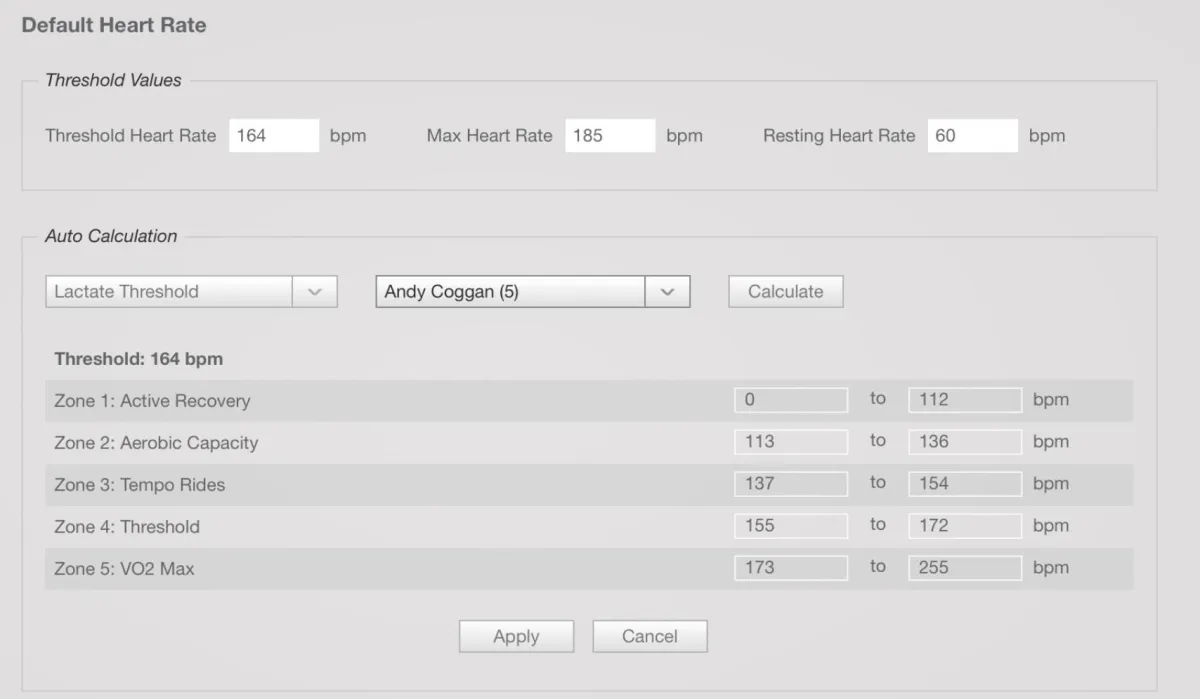
For bike heart rate please do the same process.

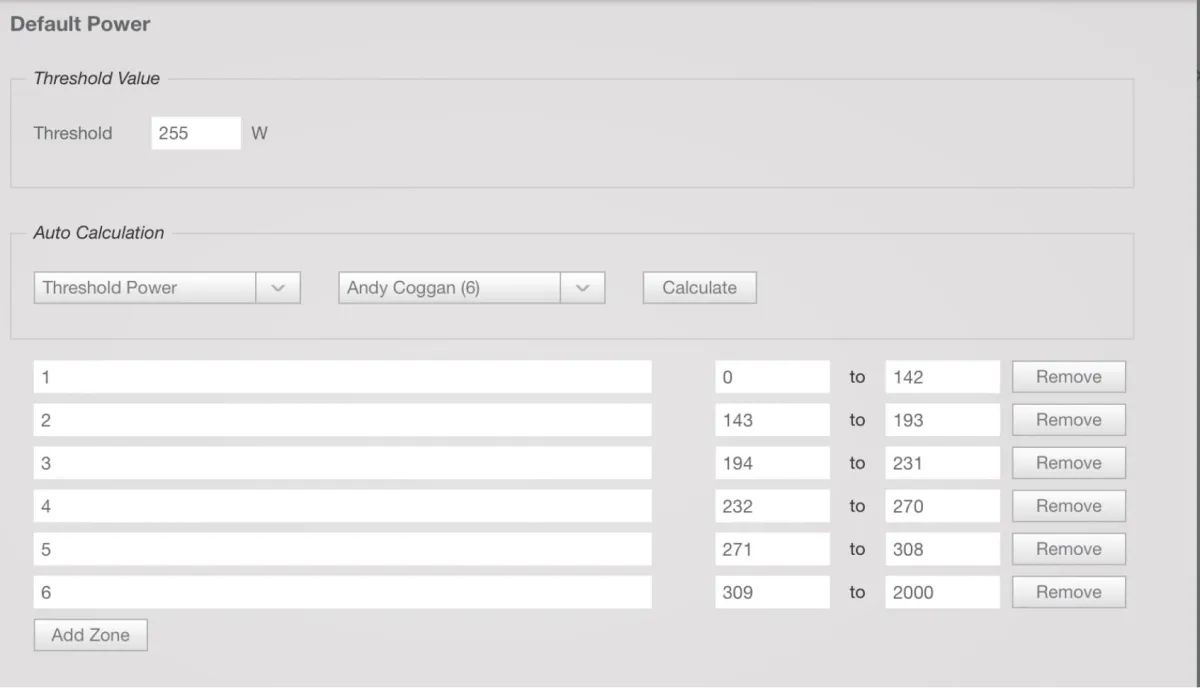
For ‘FTP’, again the same process again using Andy Coggan’s algorithm.
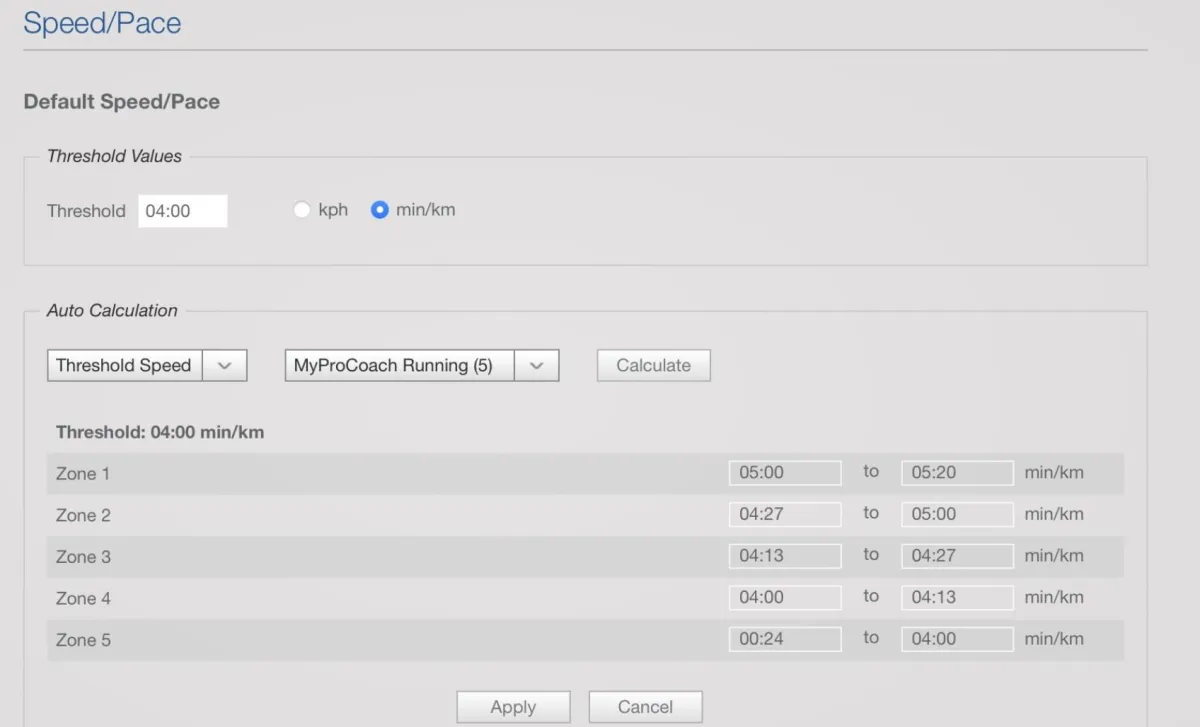
For ‘Threshold Pace’- Please complete the same process but select ‘MyProCoachRunning’ to determine the pace zones.
For your ‘threshold swim pace’, please do the same process selecting ‘MyProCoach Swimming’ to determine the zones.

Determining training zones off perceived effort
Wrist based heart rate (Garmin/Apple watch etc) tends to be quite inaccurate compared to using those watches connected to a chest strap. To the point that we prefer to use perceived effort over wrist based heart rate measurements on the run.
If getting a chest strap is not an option right now here is a good guide for how each zone should feel:
Zone 1- Very very easy. Minimal or no glycogen cost for the good fat burners. Brisk walk, slow jog for the more elite, easy social ride sort of vibe.
Zone 2- Easy to moderate. Should be able to hold a conversation although not necessarily a flowing conversation once you hit high zone 2. Zone 2 mid-high still takes some concentration and effort if you're going 75 minutes +.
Zone 2 is the aerobic base development base where the majority of your training should be done to develop aerobic efficiency and maximise fat burning development.
Zone 3- Specific race conditioning. Getting hard but still sustainable. Talking possible for brief sentences but not comfortable and quite broken. Can hear yourself breathing heavily but not as frequent and loud as zone 4. We’re maximising aerobic conditioning of your type 2a fibres and really developing race specific muscular conditioning.
Zone 4- Hard. Anaerobic threshold/ LT 2 Best sustainable output for 30-75 minutes. Can really hear yourself breathing hard. For the fit- typically breathing every out every time your left or right leg hits the ground while running.
Zone 5- Extremely hard- Vo2 max. Gasping breathes. Typically short, hard intervals sub 2.5 minutes in duration.